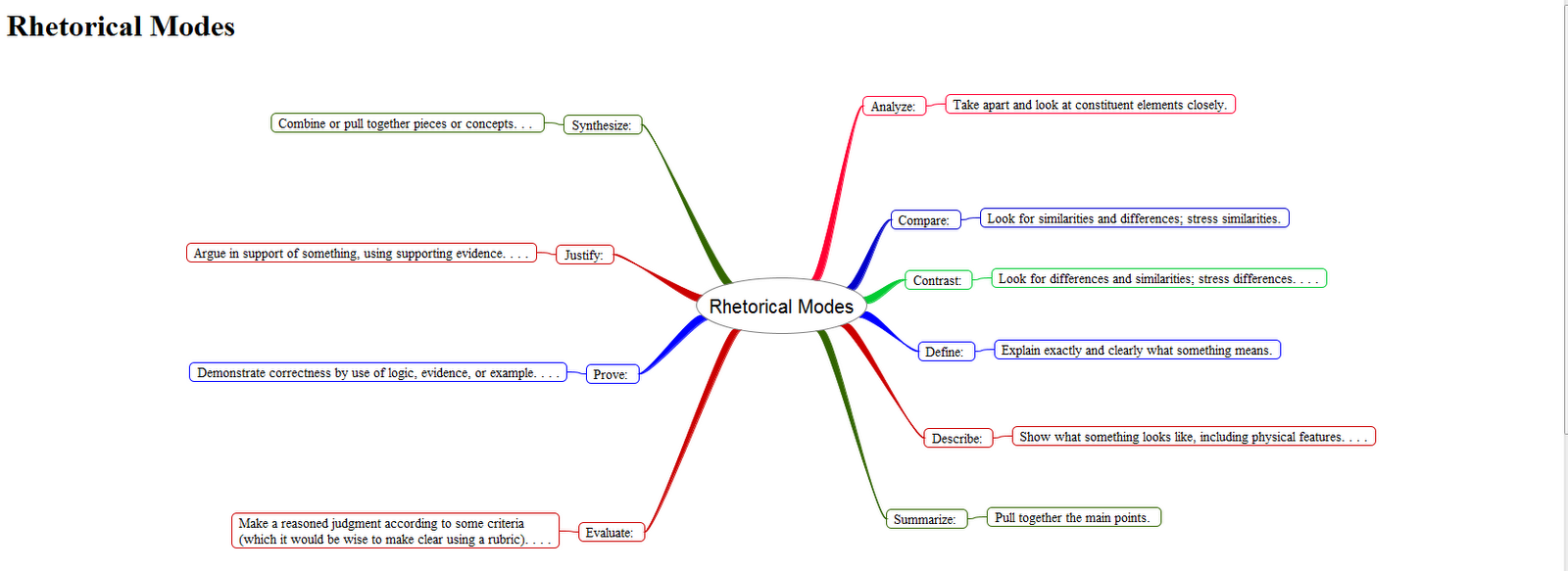
As a writer, you can begin by asking yourself questions and then answering them. Your answers will bring your subject into focus and provide,you with the material to develop your topic. Here are twenty questions or “thought starters” that present ways of observing or thinking about your topic. Each question generates the type of essay listed in parentheses after the question.
1. What does X mean? (Definition)
2. What are the various features of X? (Description)
3. What are the component parts of X? (Simple Analysis)
4. How is X made or done? (Process Analysis)
5. How should X be made or done? (Directional Analysis)
6. What is the essential function of X? (Functional Analysis)
7. What are the causes of X? (Causal Analysis)
8. What are the consequences of X? (Causal Analysis)
9. What are the types of X? (Classification)
10. How is X like or unlike Y? (Comparison)
11. What is the present status of X? (Comparison)
12. What is the significance of X? (Interpretation)
13. What are the facts about X? (Reportage)
14. How did X happen? (Narration)
15. What kind of person is X? (Characterization/Profile)
16. What is my personal response to X? (Reflection)
17. What is my memory ofX? (Reminiscence)
18. What is the value of X? (Evaluation)
19. What are the essential major points or features of X? (summary)
20. What case can be made for or against X? (Persuasion)