Thursday, October 13, 2011

Essay Exams: Tips for Writing Essay Exams


Tips for Writing Essay Exams
from  
http://depts.washington.edu/pswrite/essayex.html

Before the Exam: Prepare and Practice 

Writing a good essay requires synthesis of material that cannot be done in the 20-30 minutes you have during the exam. In the days before the exam, you should:
  • Anticipate test questions. Look at the question from the last exam. Did the question ask you to apply a theory to historical or contemporary events? Did you have to compare/contrast theories? Did you have to prove an argument? Imagine yourself in the role of the instructor--what did the instructor emphasize? What are the big ideas in the course?
  • Practice writing. You may decide to write a summary of each theory you have been discussing, or a short description of the historical or contemporary events you've been studying. Focus on clarity, conciseness, and understanding the differences between the theories.
  • Memorize key events, facts, and names. You will have to support your argument with evidence, and this may involve memorizing some key events, or the names of theorists, etc.
  • Organize your ideas. Knowledge of the subject matter is only part of the preparation process. You need to spend some time thinking about how to organize your ideas. Let's say the question asks you to compare and contrast what regime theory and hegemonic stability theory would predict about post-cold war nuclear proliferation. The key components of an answer to this question must include:
  • A definition of the theories
  • A brief description of the issue
  • A comparison of the two theories' predictions
  • A clear and logical contrasting of the theories (noting how and why they are different)
In the exam 

Many students start writing furiously after scanning the essay question. Do not do this! Instead, try the following:
  • Perform a "memory dump." Write down all the information you have had to memorize for the exam in note form.
  • Read the questions and instructions carefully. Read over all the questions on the exam. If you simply answer each question as you encounter it, you may give certain information or evidence to one question that is more suitable for another. Be sure to identify all parts of the question.
  • Formulate a thesis that answers the question. You can use the wording from the question. There is not time for an elaborate introduction, but be sure to introduce the topic, your argument, and how you will support your thesis (do this in your first paragraph).
  • Organize your supporting points. Before you proceed with the body of the essay, write an outline that summarizes your main supporting points. Check to make sure you are answering all parts of the question. Coherent organization is one of the most important characteristics of a good essay.
  • Make a persuasive argument. Most essays in political science ask you to make some kind of argument. While there are no right answers, there are more and less persuasive answers. What makes an argument persuasive?
  • A clear point that is being argued (a thesis)
  • Sufficient evidenct to support that thesis
  • Logical progression of ideas throughout the essay
  • Review your essay. Take a few minutes to re-read your essay. Correct grammatical mistakes, check to see that you have answered all parts of the question.
Things to Avoid 

Essay exams can be stressful. You may draw a blank, run out of time, or find that you neglected an important part of the course in studying for the test. Of course, good preparation and time management can help you avoid these negative experiences. Some things to keep in mind as you write your essay include the following:
  • Avoid excuses. Don't write at the end that you ran out of time, or did not have time to study because you were sick. Make an appointment with your TA to discuss these things after the exam.
  • Don't "pad" your answer. Instructors are usually quite adept at detecting student bluffing. They give no credit for elaboration of the obvious. If you are stuck, you can elaborate on what you do know, as long as it relates to the question.
  • Avoid the "kitchen sink" approach. Many students simply write down everything they know about a particular topic, without relating the information to the question. Everything you include in your answer should help to answer the question and support your thesis. You need to show how/why the information is relevant -- don't leave it up to your instructor to figure this out!

Essay Exams


Testing with success series

from 

http://www.studygs.net/tsttak4.htm


The Essay Exam

Organization and neatness have merit
Before writing out the exam:
    • Write down their key words, listings, etc, as they are fresh in your mind.
      Otherwise these ideas may be blocked (or be unavailable) when the time comes to write the later questions. This will reduce "clutching" or panic (anxiety, actually fear which disrupts thoughts).
    Set up a time schedule to answer each question and to review/edit all questions
    • If six questions are to be answered in sixty minutes,
      allow yourself only seven minutes for each
    • If questions are "weighted",
      prioritize that into your time allocation for each question
    • When the time is up for one question, stop writing,
      leave space, and begin the next question. The incomplete answers can be completed during the review time
    • Six incomplete answers will usually receive more credit than three, complete ones
Read through the questions once and note if you have any choice in answering questions
    • Pay attention to how the question is phrased,
      or to the "directives", or words such as "compare", "contrast", "criticize", etc. See their definitions in "Essay terms"
    • Answers will come to mind immediately for some questions
Before attempting to answer a question, put it in your own words
    • Now compare your version with the original.
      Do they mean the same thing? If they don't, you've misread the question. You'll be surprised how often they don't agree.
    Think before you write: Make a brief outline for each question Number the items in the order you will discuss them
    • Get right to the point
      State your main point in the first sentence
      Use your first paragraph to provide an overview of your essay.
      Use the rest of your essay to discuss these points in more detail.
      Back up your points with specific information, examples, or quotations from your readings and notes
      • Teachers are influenced by compactness,
        completeness and clarity of an organized answer
      • Writing in the hope
        that the right answer will somehow turn up is time-consuming and usually futile
      • To know a little and to present that little well is,
        by and large, superior to knowing much and presenting it poorly--when judged by the grade received.
    Writing & answering:
    Begin with a strong first sentencethat states the main idea of your essay. Continue this first paragraph by presenting key points
    Develop your argument
      • Begin each paragraph
        with a key point from the introduction
      • Develop each pointin a complete paragraph
      • Use transitions,or enumerate, to connect your points
      • Hold to your timeallocation and organization
      • Avoid very definite statements
        when possible; a qualified statement connotes a philosophic attitude, the mark of an educated person
      • Qualify answers when in doubt.
        It is better to say "toward the end of the 19th century" than to say "in 1894" when you can't remember, whether it's 1884 or 1894. In many cases, the approximate time is all that is wanted; unfortunately 1894, though approximate, may be incorrect, and will usually be marked accordingly.
    Summarize in your last paragraphRestate your central idea and indicate why it is important.
    Review:
    Complete questions left incomplete,but allow time to review all questions
    Review, edit, correctmisspellings, incomplete words and sentences, miswritten dates and numbers.
    Not enough time?
        Outline your answers

Schedule Fall 2011


Session
Date
Assignment Due
W 1
25-Aug
Unit 1 Introduction
Where do you stand with regard to writing? (feet, stomach, heart, ears, eyes, hands, brain)
W 2
1-Sep
Introductory Essay Assigned: Consider each of the following contexts: Personal (family), Social (culture, home country), Professional (economic now/future), Universal (philosophical, goals, definition of success)
TCW, Process of Writing:  C1-8
W 3
8-Sep
Unit 1 Essay -- Introductory Essay -- Due
Presentations
Peer Evaluation
W 4
15-Sep
Unit 2: Language, Literature, Art, Music, Humanities Focus
Media: Story of English; Do You Speak American?
W 5
22-Sep
The College Writer (TCW), C24, Writing about Literature and the Art; MLA Format
W 6
29-Sep
Literary Analysis (TCW, C24, 357), oral presentation (TCW, C21, 319, Observation Report), web writing (TCW, C27, 399) http://www.wisc.edu/writing/Handbook/ReadingPoetry.html
W 7
6-Oct
TCW, C25, Academic Essay Tests
Unit 2 --Humanities Essay -- Due
W 8
13-Oct
Review; Presentations; ePortfolios: PowerPoint/Blog/Maps/Outlines
W 9
20-Oct
Midterm
W 10
27-Oct
Essay Unit 3 Social Sciences Focus
TCW, C26, Writing for the Workplace
W 11
3-Nov
TCW, C27 Writing and Designing in the Web Business, Economics America at Work
APA Format, TCW, C34 Abstracts/summaries(538,540,550) Research C29-32,
W 12
10-Nov
Unit 3 -- Social Sciences -- Essay Due
Presentations
Unit 4 Cosmos Physical Sciences
Nature/ Ecology
W 13
17-Nov
Microcosmos
Field Report (TCW C23, 341), research paper (TCW, C29, 423)
Experiment report (TCW C23, 341), observation report (TCW C21, 319), research paper(TCW C29, 423)
24-Nov
Fall Recess
W 14
1-Dec
Unit 4 -- Physical Sciences-- Essay Due
Review Presentations
Conclusion
W 15
8-Dec
Final

Student Blogs Fall 2011

Thursday, September 29, 2011

Humanities: Music -- Amazing Grace


The Moyers Collection: Amazing Grace with Bill Moyers


SYNOPSIS

This unique documentary presents adaptations of an enduring hymn, from country music to gospel to folk, in one of PBS’ highest-rated programs ever. Judy Collins sings in Columbia’s St. Paul’s Chapel, then recalls how “Amazing Grace” carried her past alcoholism. Jessye Norman sends “Amazing Grace” soaring across Manhattan Center footlights. Hear Johnny Cash, Jean Ritchie, and the Boys Choir of Harlem, all recorded on location across America.

AWARDS
Director’s Guild of America Award 1990 for Outstanding Directorial Achievement
Emmy, Outstanding Individual Achievement, Directing
Cine Golden Eagle Award 1990
Christopher Award
Alfred I. du-Pont-Columbia University Gold Baton (Moyers body of work)
AFI Film Festival 1990, Chicago, Boston, Leningrad Film Fests


CREDITS
Producer/Director: Elena Mannes
Editor: Donna Marino
Photography: Gary Steele, Greg Andracke, Dyanna Taylor
Executive Editors: Bill Moyers and Judith Davidson Moyers

Thursday, September 22, 2011

Graphic Organizers

 from http://www.graphic.org/goindex.html

DescribingComparing ContrastingClassifyingSequencingCausalDecision Making

Webbing
Brainstorming Web

Money Web
Double Cell DiagramHierarchy Diagram

Research Cycle Cluster Diagram

Desktop Folder System
Squirrels Web

Concept Mapping
Concept MapSimile - School is..

Matrix
Venn

Venn Expanded

Comparison Matrix
KWHLThinking grids

Flow Chart
Desktop Folder SystemLinear String

Expanded Linear String

Dominoe Effect


Some more forms: Clock, Cluster/Word Web, Describing Wheel, E-Chart, Fact and Opinion, Five W's Chart, Flow Chart, Four-Column Chart, Garden Gate, Goal-Reasons Web, Hierarchy chart, Ice-Cream Cone, Idea Rake, Idea Wheel, , Inverted Triangle, ISP Chart, KWHL Chart, KWL Chart, KWS Chart, Ladder, Observation Chart, Persuasion Map, Planning Chart, Problem Solution Chart, Progress Report, Sandwich, Sense Chart, Sequence Chart, Spider Map, Step-by-Step Chart, Story Map 1, T-Chart, Think-Pair-Share, Ticktacktoe, Time Line, Time-Order Chart, Tree Chart, Venn Diagram.
Graphic organizers are valuable tools for teaching/instruction. Unlike others, graphic organizers demonstrate a felxibility and endlessness in choices of use. A common trait is their ability to show the order and completeness of the student's thought process - how s/he understands becomes clearly evident. Using a range of graphic organizers shows both the close-up and the larger picture. Since many graphic organizers use short words or phrases, they are ideal for many types of learners including those for whom English as a second language.

Paragraph Structure Worksheet


Brainstorming Chart Template

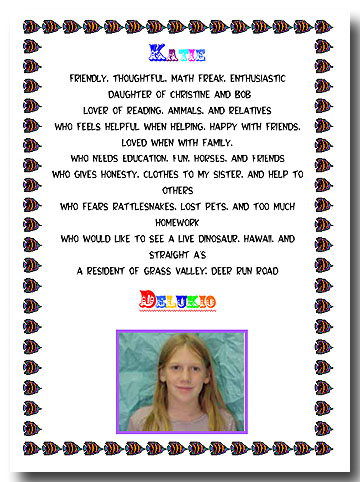
Bio Poem Example


Bio Poem Some Vocab Examples

absentminded
accidental
acid
actual
adventurous
afterwards
almost
always
angry
annual
anxious
arrogant
awkward

B

bad
bashful
beautiful
bitter
bleak
blind
blissful
boastful
bold
brave
brief
bright
brisk
broad
busy

C
calm
careful
careless
cautious
certain
cheerful
clear
clever
close
coaxing
colorful
common
continual
cool
correct
courageous
cross
cruel
curious

D
daily
dainty
dear
deceiving
delightful
deep
defiant
deliberate
delightful
diligent
dim
doubtful
dreamy

E
easy
elegant
energetic
enormous
enthusiastic
equal
especial
even
even
eventual
exact
excited
extreme

F
fair
faithful
famous
far
fast
fatal
ferocious
fervent
fierce
fond
foolish
fortunate
frank
frantic
free
frenetic
frightful
furious

G
general
generous
gent
glad
gleeful
graceful
grateful
great
greed
H
happy
hasty
healthy
heavy
helpful
helpless
high
honest
hopeless
hour
hungry

I

immediate
innocent
inquisitive
instant
intense
intent
interesting
inward
irritable
jagged
jealous
joshing
joyful
joyous
jovial
jubilant
judgmental
just

K

keen
kidding
kindhearted
kind
kissing
knavish
knotty
knowing
knowledgeable

L
lazy
less
light
like
limp
live
lofty
longing
loose
loving
loud
loyal

M
mad
majestic
meaningful
mechanical
merry
miserable
mocking
month
more
mortal
most
mysterious
N
natural
near
neat
needy
nervous
never
nice
noisy

O
obedient
obnoxious
odd
offensive
official
often
on
open
optimistic
overconfident
owlish

P
painful
partial
patient
perfect
physical
playful
polite
poor
positive
potential
powerful
prompt
proper
punctual

Q
quaint
quarrelsome
queasy
queer
questionable
questioning
quicker
quick
quiet
quirky
quizzical

R
rapid
rare
ready
real
reassuring
reckless
regular
reluctant
repeated
reproachful
restful
righteous
rightful
rigid
rough
rude

S
sad
safe
scarce
scary
searching
sedate
seeming
seldom
selfish
separate
serious
shaky
sharp
sheepish
shrill
shy
silent
sleepy
slow
smooth
soft
solemn
solid
sometimes
soon
speedy
stealthy
stern
strict
successful
sudden
surprising
suspicious
sweet
swift
sympathetic

T
tender
tense
terrible
thankful
thorough
thoughtful
tight
tomorrow
too
tremendous
triumphant
true
truthful

U
ultimate
unabashed
unaccountable
unbearable
unethical
unexpected
unfortunate
unimpressive
unnatural
unnecessary
utter
upbeat
uplifting
upright
upside-down
upward
upward
urgent
useful
useless
usual
utter

V
vacant
vague
vain
valiant
vast
verbal
very
vicious
victorious
violent
vivacious
voluntary
W
warm
weak
weary
well
wet
whole
wild
willful
wise
woeful
wonderful
worried
wrong

Y
yawning
year
yearning
yesterday
yielding
youthful

Z
zealous
zestful
zesty