Friday, February 9, 2007

Writing Summaries

Summaries-- What are they?

Definition: a brief restatement in your own words of a text's main ideas (Holt Handbook, 5th edition); a condensation of an extended idea or argument into a sentence or more in your own words" (Little, Brown Handbook, 5th edition).

Characteristics:

Summaries identify the source of original text.

Summaries demonstrate your understanding of a text's subject matter.

Summaries are shorter (at least 60% shorter) than the original text--they omit the original text's examples, asides, analogies, and rhetorical strategies: (Holt Handbook, 5th edition).

Summaries differ from paraphrases--paraphrases more closely follow the original text's presentation (they still use your words, but they are longer than summaries).

Summaries focus exclusively on the presentation of the writer's main ideas--they do not include your interpretations or opinions.

Summaries normally are written in your own words--they do not contain extended quotes or paraphrases.

Summaries rely on the use of standard signal phrases ("According to the author..."; "The author believes..."; etc.).

Tips on Writing Summaries

Step One (Prewriting): Read the article quickly. Try to get a sense of the article's general focus and content.

Step Two (Drafting): Restate the article's thesis simply and in your own words. Restate each paragraph's topic simply and in your own words.

Step Three (Revising): Combine sentences in Step Two to form your summary; Organize your summary sentences in the same order as the main ideas in the original text. Edit very carefully for neatness and correctness.

Criteria for Effective Writing Skills

Criteria for Effective Writing Skills
(words in parentheses indicate highest level of proficiency)


Writer's ability to . . .


Overall
a) stay (completely) focused on topic and task
b) organize ideas (logically)
c) exhibit (exceptional) word usage
d) demonstrate (exceptional) writing technique
e) (effectively) adjust language and tone to task and reader

Specific Areas
Ideas
a) unify theme or main idea
b) not go off on tangents
c) fully accomplish the task (summary, essay, article...)
d) fully explore many facets of the topic

Organization
a) create a cohesive, meaningful whole (i.e. introduction, body, and conclusion)
b) progress in an order that enhances meaning
c) make smooth transitions between ideas, sentences and paragraphs to enhance meaning of text

Style
a) choose vocabulary to make explanations detailed and precise, descriptions rich, and actions clear and vivid
b) demonstrate control of a challenging vocabulary
c) use varied sentence patterns and complex sentences (yet fluent and easy to read)
d) uses writer's techniques (i.e. literary conventions such as imagery, humor etc.)

Voice
a) choose appropriate register (i.e. formal, personal, or dialect) to suit task
b) display a strong sense of audience (the readers)
c) have a unique perspective; may be original, authoritative, lively and/or exciting

Mechanics
a)words should have no or few capitalization errors
b) sentences should have no or few punctuation errors
c) words should have no or few spelling errors
d) sentences should have no or few grammar or word usage errors
e) good writing has no or few paragraphing errors
f) good writing has no or few run-on sentences or sentence fragments

Writing Activities from College Writer Text

English 82A Written Communication College Writer Text
For English 82A -- Written Communication -- our course textbook, The College Writer, has the following excellent web site:
http://college.hmco.com/english/vandermey/college_writer/1e/students/


College Writer: Writing Activities
Step-by-Step Writing Assignments
Reading Notes: One Writer's Process, several mini-assignments with a topic and raw material, including source articles and research links

Annotated ReadingsJournal SupportInteractive journal assignments that reflect the content of each chapter

Test Your Reading Comprehension Answer questions about a short reading(image placeholder)(image placeholder)

Visual Activities Writing assignments based on visuals to help readers learn to see the visual environment and to think critically or interpret it

Music Activites Extensive activities based on musical passages that demonstrate the principles for the patterns of writing development

Game Fun ways to help you learn how to revise an essay into a unified and coherently organized whole

Interactive Calendar A planner that helps you schedule the time needed for a each stage of a writing assignment

Publishing Your Work A resource center for venues that accept student papers, advice on submitting your work

Real-World Web Links Links to sites and subjects that demonstrate the underlying principles for the patterns of writing development

100 Words to Know Increase your vocabulary using these flashcards derived from The American Heritage College Dictionary list of the top 100 words you should know.

Writing Activities from College Writer Text

English 82A Written Communication College Writer Text
For English 82A -- Written Communication -- our course textbook, The College Writer, has the following excellent web site:
http://college.hmco.com/english/vandermey/college_writer/1e/students/


College Writer: Writing Activities
Step-by-Step Writing Assignments
Reading Notes: One Writer's Process, several mini-assignments with a topic and raw material, including source articles and research links

Annotated ReadingsJournal SupportInteractive journal assignments that reflect the content of each chapter

Test Your Reading Comprehension Answer questions about a short reading(image placeholder)(image placeholder)

Visual Activities Writing assignments based on visuals to help readers learn to see the visual environment and to think critically or interpret it

Music Activites Extensive activities based on musical passages that demonstrate the principles for the patterns of writing development

Game Fun ways to help you learn how to revise an essay into a unified and coherently organized whole

Interactive Calendar A planner that helps you schedule the time needed for a each stage of a writing assignment

Publishing Your Work A resource center for venues that accept student papers, advice on submitting your work

Real-World Web Links Links to sites and subjects that demonstrate the underlying principles for the patterns of writing development

100 Words to Know Increase your vocabulary using these flashcards derived from The American Heritage College Dictionary list of the top 100 words you should know.

Welcome

Welcome to 4writingmatters.blogspot.com

Wednesday, February 7, 2007

Spelling and Pronunciation


Spelling Rules
syllablesEvery syllable has one vowel sound.
cC can be prounced as /k/ or /s/.
cC is pronounced as /s/ before an e, i, or y (cent, city, cycle).
cIt is pronounced as /k/ before everything else (cat, clip).
gG is pronounced as /g/ or /j/.
gG may be pronounced as /j/ before an e, i, or y (gem, giant, gym).
gIt is pronounced as /g/ before everything else (garden, glad).
qQ is always followed by a u (queen).
f, l,sDouble the consonants f, l, and s at the end of a one-syllable word that has just one vowel (stiff, spell, pass).
kTo spell the sound of /k/ at the end of a word, we use ck or k. Use ck after a short vowel (sick). After everything else, use a k (milk).
a,e,o,uA, e, o, and u usually say their name at the end of a syllable (a-pron, me, go, u-nit).
v, jWords do not end in v or j. We add a silent-e at the end of the word (have).
I,oI and o may be pronounced as /i/ and /o/ before two consonants (kind, sold).
j/J/ is spelled dge after a short vowel (edge).

Monday, February 5, 2007

Syllabus

English 82B Syllabus Lincoln University
Written Communication II
Dr. Sylvia Y. R. Schoemaker

Phone: 510.628.8036
Semester: Spring 2007
Units: 3 Contact hours: 40
Course Days: T Time: 9:30 – 12:15; Location: Room 302
Course sites:
http://wcom072.blogspot.com/
Course Website:
writCommunication.tripod.com;
Office: Room 305
Office Hours: T-T, 9:9:30, 12:15-1, and by arrangement
E-mail:
docsyl072@gmail.com


Objectives
You will develop your writing skills for academic, professional, and socio-cultural purposes, in context-centered essay writing. You will learn editing, documentation skills, use of online and other resources.


University learner goals 1 -6, and specifically in English:: To develop
basic academic and professional skills(1); To develop the ability to communicate
effectively in English, orally and in writing, and to read with understanding
(1.1) and institutional goals , especially 1,(1.1-1.4), 2.4

Description:
English 82B covers the aspects of composing well-organized written communications in functional contexts. The core of the course will emphasize practice in organizing ideas in a clear, logical manner and other elements involved in writing papers in various applied contexts.


Catalog Description: ENG 82A & 82B - WRITTEN COMMUNICATION I, II

ENG 82A & 82B - WRITTEN COMMUNICATION I & II
First term: A thorough study of grammar and the fundamentals of composition. Practice
in writing themes, book reviews and other short papers is given. Particular
attention is directed toward sentence structure, syntax, and general rhetorical
principles. Second term: Critical reading and evaluation of selected texts and
writings; composition of well-organized expository papers; a careful
consideration of methods of research, organization in a clear, logical manner
and other elements involved in writing research papers. (3 + 3
units)


Course Materials
Required Texts

VanderMey et al. The College Writer. Second Edition. Boston: Houghton Mifflin Company, 2007.
Dictionary, thesaurus
Library cardFormat

A cooperative learning model is employed. Small group and individual discovery exercises and presentations will augment lectures, discussion and applications.


Student Responsibilities:
Students are expected to attend class, to complete assignments, to participate in the course in a productive manner, and to take personal responsibility for meeting the objectives of the course.

Evaluation/Grading:
Essays, assignments, exercises, class participation, portfolios /projects, presentations, midterm and final (see schedule) are averaged in determining the final grade in the following proportions:

Essays: 20%)
Homework/in-class work: 20%
Midterm:20%
Final:20%
Projects: 20%
Policies:
· Assignments are to be submitted in a timely manner. Late work will receive
reduced points and must be accompanied with a written explanation for its
tardiness.
· Plagiarized work will receive 0 points, and if persistent will
result in course failure.
· All assignments must be typed, include in the
top right hand corner your name, course, date submitted, assignment name and
revision number.
· Attendance is mandatory. Missed classes will constitute 0
points for the day’s class participation points. Excused absences are limited to
serious medical or other problems, and are to be explained in writing either
before or immediately after the absence. Persistent unexcused absences will
result in course failure.

Assignment Schedule


UnitWeekDateTopics/AssignmentNotes
Unit 1Wk 1 1/16/2007IntroductionRecommended reference texts: Handbook, Dictionaries
IntroductionWk 2 1/23/2007Introductory Essay: Personal (family), Social (culture, home country), Professional (economic now/future), Universal (philosophical, goals, definition of success)QnA-- Interviews

Essay: Where do you stand? (feet, stomach, heart, ears, eyes, hands, brain)
Wk3 1/30/2007Peer EvaluationUnit 1 Paper Due
Unit 2: Wk 42/6/2007

Introductory essay due

Language, Literature, Art, Music

Story of English;

Do You Speak American?
Humanities FocusWk 52/13/2007C24, Writing about Literature and the ArtsMLA Format
Wk 62/20/2007Literary Analysis (357), oral presentations (319), web writing (399)
Wk 72/27/2007C25, Academic EssaysUnit 2 Paper Due
Wk 83/6/2007Review; Presentations
Wk 93/13/2007Midterm
3/20/2007Spring Recess
Unit 3Wk 10 3/27/2007C26, Writing for the WorkplaceAPA Format
Social Sciences FocusWk 114/3/2007Abstracts/summaries(538,540,550)Business, Economics

America at Work
Wk 124/10/2007experiment report (341), observation report (319), research paper(423)Unit 3 Paper Due
Unit 4Wk 134/17/2007C27,, Writing and Designing in the WebCosmos
Physical SciencesWk 144/24/2007Field Report (341), research paper (423)Nature/ Ecology

Micrososmos
Wk 155/1/2007Review; PresentationsUnit 4 Paper Due
ConclusionWk 165/8/2007 Final

Wednesday, January 31, 2007

SQ4R Method

SSurvey
QQuestions
4RRead Read the text. Use a pencil or pen to mark the text (Do not use a highlight marker!). Underline, star, or flag vocabulary words or ideas that you think are important.
Respond As you read, try to find the answers to the questions you asked. Remember, as you read, you might ask more questions. Be sure to write your answers in the margins.
ReviewWhen you finish reading, review the written text. Can you answer the questions that you asked? Do you understand everything about the written text? If the author(s) were sitting next to you, what other questions would you ask?
ReflectClose the text. Think about what your have read. Discuss the main points with someone. Do you agree or disagree with the author(s)? What surprised you about the written text? What did you find to be interesting? What did you find to be confusing? What did you learn?

Parts of Speech

n. (noun) - a name word; name of a person, place, thing, or idea
pn. (pronoun) - a word used in place of a noun
vb.(verb) - word for an action or state of being
adj. (adjective) - a describing word
adv. (adverb) - aa modigying word
prep. (preposition) - a word used to show a relation
intj. (interjection) - an interrupting word
conj. (conjunction) - a combining word

HAVE you ever heard anyone say, “I feel badly”? Of course you have, because almost everyone seems to have the mistaken idea that “I feel bad” is awkward and inelegant. In order to understand why “I feel bad” is correct, we must understand the difference between adjectives and adverbs.

ADJECTIVES AND ADVERBS

As you recall, an adjective can modify either a noun or a pronoun; whereas an adverb modifies a verb, an adjective, or another adverb. The following chart of a sentence will enable you to fix these facts in mind. As you study the plan, remember that the subject and the object must always be nouns or other parts of speech used as nouns.

THE SENTENCE PLAN
SubjectVerbObject
AdjectiveAdverbAdjective
AdverbAdverbAdverb


Two Positions of the Adjective

Few of us have any difficulty in identifying an adjective when it is close to the noun it modifies. In each of the four sentences at the top of Page 4, the adjective immediately precedes the noun it modifies.

Check Your Spelling, Anyone? -- from the Net

The Trouble with Spell Checkers

Pome

1
I have a spelling checker -
It came with my PC.
It plane lee marks four my revue
Miss steaks aye can knot sea.

2
Eye ran this poem threw it,
Your sure reel glad two no.
Its vary polished in it's weigh,
My checker tolled me sew.

3
A checker is a bless sing,
It freeze yew lodes of thyme.
It helps me right awl stiles two reed,
And aides me when aye rime.

4
To rite with care is quite a feet
Of witch won should be proud.
And wee mussed dew the best wee can,
Sew flaws are knot aloud.

5
And now bee cause my spelling
Is checked with such grate flare,
Their are know faults with in my cite,
Of nun eye am a wear.

6
Each frays come posed up on my screen
Eye trussed to bee a joule
The checker poured o'er every word
To cheque sum spelling rule.

7
That's why aye brake in two averse
By righting wants too pleas.
Sow now ewe sea why aye dew prays
Such soft wear for pea seas!

Why English is Baffling

1 The bandage was wound around the wound.
2 The farm was used to produce produce.
3 The dump was so full that it had to refuse more refuse.
4 We must polish the Polish furniture.
5 He could lead if he would get the lead out.
6 The soldier decided to desert his dessert in the desert.
7 Since there is no time like the present, he thought it was time to present the present.
8 A bass was painted on the head of the bass drum.
9 When shot at, the dove dove into the bushes.
10 I did not object to the object.
11 The insurance was invalid for the invalid.
12 There was a row among the oarsmen about how to row.
13 They were too close to the door to close it.
14 The buck does funny things when the does are present.
15 A seamstress and a sewer fell down into a sewer line.
16 To help with planting, the farmer taught his sow to sow.
17 The wind was too strong to wind the sail.
18 After a number of injections my jaw got number.
19 Upon seeing the tear in the painting I shed a tear.
20 I had to subject the subject to a series of tests.
21 How can I intimate this to my most intimate friend?

Reading Strategies

Reading Strategies
1. Learn to read actively.
2. Understand the vocabulary in context
3. Look for basic structures in what you read
4. Make inferences
5. Appreciate the writer's craft: intros, conclusions, signal words, type of support, patterns of organization, tone, purpose, audience, signal words (connectors, time words, transitions)
6. Learn to outline or map and summarize
7. Discuss your ideas

Reading Comprehension Tips from How to be a Successful Student


How to Improve Reading Comprehension

Key Point

Good reading means building frameworks for connecting words to thoughts.

The Purpose of Reading.


The purpose of reading is to connect the ideas on the page to what you already know. If you don't know anything about a subject, then pouring words of text into your mind is like pouring water into your hand. You don't retain much. For example, try reading these numbers:


7516324 This is hard to read and remember.

751-6324 This is easier because of chunking.

123-4567 This is easy to read because of prior knowledge and structure.


Similarly, if you like sports, then reading the sports page is easy. You have a framework in your mind for reading, understanding and storing information.


Improving Comprehension.

Reading comprehension requires motivation, mental frameworks for holding ideas, concentration and good study techniques. Here are some suggestions.


Develop a broad background.

Broaden your background knowledge by reading newspapers, magazines and books. Become interested in world events.

Know the structure of paragraphs.

Good writers construct paragraphs that have a beginning, middle and end. Often, the first sentence will give an overview that helps provide a framework for adding details. Also, look for transitional words, phrases or paragraphs that change the topic.


Identify the type of reasoning.

Does the author use cause and effect reasoning, hypothesis, model building, induction or deduction, systems thinking? See section 20 for more examples on critical thinking skills.


Anticipate and predict.

Really smart readers try to anticipate the author and predict future ideas and questions. If you're right, this reinforces your understanding. If you're wrong, you make adjustments quicker.


Look for the method of organization.

Is the material organized chronologically, serially, logically, functionally, spatially or hierarchical? See section 10 for more examples on organization.


Create motivation and interest.

Preview material, ask questions, discuss ideas with classmates. The stronger your interest, the greater your comprehension.


Pay attention to supporting cues.

Study pictures, graphs and headings. Read the first and last paragraph in a chapter, or the first sentence in each section.


Highlight, summarize and review.

Just reading a book once is not enough. To develop a deeper understanding, you have to highlight, summarize and review important ideas.


Build a good vocabulary.

For most educated people, this is a lifetime project. The best way to improve your vocabulary is to use a dictionary regularly. You might carry around a pocket dictionary and use it to look up new words. Or, you can keep a list of words to look up at the end of the day. Concentrate on roots, prefixes and endings.


Use a systematic reading technique like SQR3.

Develop a systematic reading style, like the SQR3 method and make adjustments to it, depending on priorities and purpose. The SQR3 steps include Survey, Question, Read, Recite and Review. See Section 14 for more details.


Monitor effectiveness.

Good readers monitor their attention, concentration and effectiveness. They quickly recognize if they've missed an idea and backup to reread it.


Should You Vocalize Words?


Yes, although it is faster to form words in your mind rather than on your lips or throat. Eye motion is also important. Frequent backtracking slows you down considerably.

Copyright 1991 Donald Martin, How to be a Successful Student

RComp Links

Links

Freemind

Reading Exercises Online

Tales of Wonder

Career Skill and Ability Videos

Saturday, January 20, 2007

Write On, Laugh On

HOW TO WRITE GOOD [sic]*
Thanks to: Chani Silverberg for this contribution

*Note: [sic] or (sic) (from Latin sic for "thus") is a bracketed expression used to indicate that an unusual spelling, phrase, or any other preceding quoted material is intended to be read or printed exactly as shown (rather than being an error) and should not be corrected.... from: en.wikipedia.org/wiki/SIC


My several years in the word game have learnt [sic] me several rules:

1. Avoid alliteration. Always.
2. Prepositions are not words to end sentences with.
3. Avoid cliches like the plague. (They're old hat.)
4. Employ the vernacular.
5. Eschew ampersands & abbreviations, etc.
6. Parenthetical remarks (however relevant) are unnecessary.
7. It is wrong to ever split an infinitive.
8. Contractions aren't necessary.
9. Foreign words and phrases are not apropos.
10. One should never generalize.
11. Eliminate quotations. As Ralph Waldo Emerson once said:
"I hate quotations. Tell me what you know."
12. Comparisons are as bad as cliches.
13. Don't be redundant; don't more use words than necessary;
it's highly superfluous.
14. Profanity sucks.
15. Be more or less specific.
16. Understatement is always best.
17. Exaggeration is a billion times worse than understatement.
18. One-word sentences? Eliminate.
19. Analogies in writing are like feathers on a snake.
20. The passive voice is to be avoided.
21. Go around the barn at high noon to avoid colloquialisms.
22. Even if a mixed metaphor sings, it should be derailed.
23. Who needs rhetorical questions?

Wednesday, January 17, 2007

Where do you stand

FEET: What do I stand for as a foundation of reading comprehension?

STOMACH: What upsets me about reading comprehension?

HEART: What do I love about reading comprehension?

HANDS: What do I feel about reading comprehension?

EARS: What do I hear about reading comprehension?

EYES: What do I see about reading comprehension?

BRAIN: What do I think about reading comprehension?

Saturday, January 13, 2007

Welcome

Welcome to the blog for Reading Comprehension -- spring 2007

Friday, January 12, 2007

Where do you stand?

FEET: What do I stand for as a foundation of writing?
STOMACH: What upsets me about writing?
HEART: What do I love about writing?
HANDS: What do I feel about writing?
EARS: What do I hear about writing?
EYES: What do I see about writing?
BRAIN: What do I think about writing?

Welcome

Welcome to the blog for Written Communication II -- spring 2007


Free Counters

Free Counter

Syllabus

IEP Reading Comprehension is an intensive English course focusing on reading skills development.

Required text:
Richards, Jack C. and Samuela Eckstut-Didier. Strategic Reading 1: Building Effective Reading Skills. Los Angeles, CA: Cambridge University Press, 2006. ISBN: 0521555809.


Week Date Unit Topic
1 8/27/2009 1 Music
2 9/3/2009 2 Money
3 9/10/2009 3 Work
4 9/17/2009 4 Sports
5 9/24/2009 5 Weather
6 10/1/2009 6 Clothes
7 10/8/2009 7 Culture
8 10/15/2009 8 Outer space
9 10/22/2009 9 Animals
10 10/29/2009 10 Travel
11 11/5/2009 11 The Internet
12 11/12/2009 12 Friends
13 11/19/2009 13 Gifts
14 11/26/2009 14 Emotions
15 12/3/2009 15 Food; Sleep and dreams
16 12/10/2009 16 Post Tests


Tuesday, January 2, 2007

Spelling Internet-related words -- from Dictlionary.com

From dictionary.com:


Usage Note: The transition from World Wide Web site to Web site to website seems to have progressed as rapidly as the technology itself. The development of website as a single uncapitalized word mirrors the development of other technological expressions which have tended to evolve into unhyphenated forms as they become more familiar. Thus email has recently been gaining ground over the forms E-mail and e-mail, especially in texts that are more technologically oriented. Similarly, there has been an increasing preference for closed forms like homepage, online, and printout.

(12/7/05)

Wednesday, December 6, 2006

Wednesday, November 29, 2006

Friday, November 24, 2006

Reading Exercise: Sehtolc Gnihsaw

Sehtolc Gnihsaw


The procedure is actually quite simple. First, you arrange the items into different groups. Of course one pile may be sufficient depending on how much there is to do. If you have to go somewhere else due to lack of facilities that is the next step; otherwise, you are pretty well set. It is important not to overdo things. That is, it is better to do too few things at once than too many. In the short run this may not seem important but complications can easily arise. A mistake can be expensive as well. At first, the whole procedure will seem complicated. Soon, however, it will become just another facet of life. It is difficult to foresee any end to the necessity for this task in the immediate future, but then, one never can tell. After the procedure is completed one arranges the materials into different groups again. Then they can be put into their appropriate places. Eventually they will be used once more and the whole cycle will then have to be repeated. However, that is part of life.

Thursday, November 23, 2006

How to be Thankful from Wiki How

Do you take many things in your life for granted? By looking at the world a little differently, you just might realize how much you have to be thankful for. Here's how to stop and smell the roses.

Steps
Look around and pay attention to the people around you. You will find that everybody has something to worry or complain about, not just you. It's easy to focus on those who seem to have it all, but you never know what's going on inside. They might look happy, but they might be miserable as well. Don't look at others and think "I should have it like they do." Look at those who aren't as fortunate as you are and count your blessings.

Practice acceptance. Stop dwelling on how things should be, what could've been, and what you don't have. Recognize what you do have--whether you like it or not, it's yours to keep or to change. Accepting your lot in life is not about resigning yourself to unhappiness. It's about not wasting time lamenting or denying your problems. Take them for what they are and...
Become a problem solver. Use your lemons to make lemonade. Get in the habit of asking yourself how you can turn the negative into a positive. The most successful people in life, and those who have the most to be grateful for, are also those who've endured tremendous trials and managed to persevere and turn it all around.

Learn to see hardship as a chance to develop character. Imagine yourself looking back ten years from now and recounting your difficult circumstances, and being proud of how you handled it and worked through it.
Focus on what you can control. Stop concentrating on your situation, and on conditions and incidents that happened to you and that you have no control over. Instead, shift your focus on what you can control: your response, and your behavior.

Take joy in the small things. Blow bubbles with your kids. Play with a puppy. Get lost in the park. Goof off and have a good laugh. Life's treasures are the small pleasures. Give thanks for each small gift you receive!

Tips
Avoid negative people whose social interaction consists of comparing their lives and competing for who has it worse.

Volunteering to help those in need will help put things in perspective.

Warnings
No matter how positive and thankful you are, remember that life will always have its ups and downs. You're going to have to take the good with the bad.

Related wikiHows
How to Thank Someone
How to Write a Thank You Speech
How to Write a Thank You Letter
How to Thank the Authors of a wikiHow Page
How to Stay Positive when You Know Your Life Sucks
How to Recreate Your Life

External Links
Optimist International - Always a smile and friends to share good things and uplifting events to participate in. They are in about 33 countries.

Sunday, November 19, 2006

I'm not a TV -- from David Jaffee

From: "David Jaffee"
Subject: Satire On Classroom Dynamics
Content-type: text/plain; charset="iso-8859-1"

PODers:

A colleague suggested I post the satirical piece below. It relates to some
recent postings and reminds us that a sense of humor is vital.

I should mention that I distribute this to the students in my mass lecture
class and it generates some very good discussion.

***************************************************************************
"I Am Not A TV": Confessions of A Professor

I am not a TV! That is what I repeatedly tell my students. But I'm not
sure they get it, because when I tell them this they continue to stare at me
with expressionless faces. Again, they have failed to see the profound
insight, or even the humor, of my observation. Again, they confirm my
thesis.

How did I come to the revelation that, in the eyes of my students, I am a
television set? As a sociologist I should probably say that I arrived at
this proposition after many years of careful data collection and observation
in undergraduates courses with disengaged students. But that would be
untrue. In fact, for many years I never really noticed student expressions
and demeanor. Fresh out of graduate school, with an abundance of
self-important intellectual energy coupled with some nervousness about
public speaking, the strategy was to lecture endlessly. I would just focus
on a spot above the students heads at the back of the class and pontificate
on things sociological. However, over time, as I became more self-confident
and also more concerned with classroom dynamics, I thought it might be worth
taking a peek at their faces. This was a big mistake.

Most of the students either stared at me with no expression whatsoever --
even when I attempted a joke, or asked a question, or launched into an
animated diatribe -- or they were looking elsewhere (like out the window,
or at their notebooks, or at one another). Occasionally, some would just get
up and walk out of the classroom and then return a few moments later.
Either no eye contact, glazed eye contact, or total disregard for my human
existence. And then it hit me -- they think I'm a TV.

How else can you explain this behavior? When we watch TV -- let's say a
standup comic -- we can wear any expression we want, we can fail to laugh at
the jokes, we can fall asleep, we can go the fridge for a beer. None of this
has any impact on the comic. It continues to perform because it cannot see
us. Students treat professors the same way. They assume we canÕt see them.
So, it makes no difference what they do. Under these circumstances, why
should students bother wasting valuable energy on social niceties like a nod
of the head, a smile, or any other social cue acknowledging the humanity of
the instructor.

I once had a student who sat in the front row sleeping through the
entire class period. At the end of class I told him he would be more
comfortable sleeping in a bed. He was incredibly embarrassed, horrified,
and shocked that I had caught him engaging in this deviant academic
behavior, even though he committed the crime directly beneath my nose. Did
he think I was blind? Did he think I was totally insensitive to his
behavior? No, he thought I was a talking head who could not see the
television audience.

Another form of antisocial classroom behavior, that further cements the
case for my thesis, is represented by the student who strolls (some actually
strut), into class ten minutes late, right in front of the lecturing
instructor. It is often the same student who, 15 minutes later, gets up to
leave the class, only to schlep (they are now getting tired) back in 5
minutes later, with absolutely no self-conscious awareness of the social
impact of these actions. I should report that this behavior is clearly on
the rise. There are a number of possible explanations. Maybe there is an
evolutionary process underway involving a shrinking bladder capacity. Maybe
students are much more active today in the stock market and must constantly
contact their broker. Or, what I really suspect, students donÕt believe a
TV set will mind one way or the other.

There is a well-known concept in sociology called the looking-glass self.
It says that our sense of self is shaped by the reactions of others. Now,
if my sense of self hinged on the reaction of my students, I would be
selling advertising time to commercial sponsors or maybe trying to figure
out a way to convert myself into a full screen model (it's a good thing I
don't come with a remote).

I am now in the habit of confronting students about their classroom
demeanor and making comments to students when they walk into class late.
Students really hate this. They long for the good old days when I stared at
the back of the room and lectured to the collective unconscious. But those
days are past and my student evaluations reflect it. After all, who wants a
TV that not only observes the viewer but evaluates their behavior. How would
you like it if your TV could comment on your posture (ÒdonÕt slouchÓ) or
your eating habits (Òdo you really need that second piece of cheesecake?Ó).

So, I am not sure what strategy to pursue. However, I have been
entertaining the idea of taping myself lecturing and then having media
services televise the lectures to my students. This would make student
behavior perfectly congruous with the educational delivery mode. I would
also be integrating technology and teaching (some people think this is
important). Yes, a true televersity! Don't worry, I would still hold
office hours and attend department meetings. And if students missed a
lecture they could always catch a rerun.

David Jaffee teaches sociology at SUNY-New Paltz.
**********************************************************

David Jaffee
Department of Sociology
SUNY-New Paltz
New Paltz, NY 12561
(914) 257-3509
email: jaffeed@npvm.newpaltz.edu

Saturday, November 18, 2006

Defining Critical Thinking from criticalthinking.org

Defining Critical Thinking from http://www.criticalthinking.org

(A statement by Michael Scriven & Richard Paul for the National Council for Excellence in Critical Thinking Instruction)

Summary

Critical thinking is the intellectually disciplined process of actively and skillfully conceptualizing, applying, analyzing, synthesizing, and/or evaluating information gathered from, or generated by, observation, experience, reflection, reasoning, or communication, as a guide to belief and action. In its exemplary form, it is based on universal intellectual values that transcend subject matter divisions: clarity, accuracy, precision, consistency, relevance, sound evidence, good reasons, depth, breadth, and fairness.


It entails the examination of those structures or elements of thought implicit in all reasoning: purpose, problem, or question-at-issue; assumptions; concepts; empirical grounding; reasoning leading to conclusions; implications and consequences; objections from alternative viewpoints; and frame of reference. Critical thinking - in being responsive to variable subject matter, issues, and purposes - is incorporated in a family of interwoven modes of thinking, among them: scientific thinking, mathematical thinking, historical thinking, anthropological thinking, economic thinking, moral thinking, and philosophical thinking.

Critical thinking can be seen as having two components: 1) a set of information and belief generating and processing skills, and 2) the habit, based on intellectual commitment, of using those skills to guide behavior. It is thus to be contrasted with: 1) the mere acquisition and retention of information alone, because it involves a particular way in which information is sought and treated; 2) the mere possession of a set of skills, because it involves the continual use of them; and 3) the mere use of those skills ("as an exercise") without acceptance of their results.

Critical thinking varies according to the motivation underlying it. When grounded in selfish motives, it is often manifested in the skillful manipulation of ideas in service of one's own, or one's groups', vested interest. As such it is typically intellectually flawed, however pragmatically successful it might be. When grounded in fairmindedness and intellectual integrity, it is typically of a higher order intellectually, though subject to the charge of "idealism" by those habituated to its selfish use.

Critical thinking of any kind is never universal in any individual; everyone is subject to episodes of undisciplined or irrational thought. Its quality is therefore typically a matter of degree and dependent on , among other things, the quality and depth of experience in a given domain of thinking or with respect to a particular class of questions. No one is a critical thinker through-and-through, but only to such-and-such a degree, with such-and-such insights and blind spots, subject to such-and-such tendencies towards self-delusion. For this reason, the development of critical thinking skills and dispositions is a life-long endeavor.

Why Critical Thinking?
The Problem:
Everyone thinks; it is our nature to do so. But much of our thinking, left to itself, is biased, distorted, partial, uninformed or down-right prejudiced. Yet the quality of our life and that of what we produce, make, or build depends precisely on the quality of our thought. Shoddy thinking is costly, both in money and in quality of life. Excellence in thought, however, must be systematically cultivated.

A Definition:
Critical thinking is that mode of thinking - about any subject, content, or
problem - in which the thinker improves the quality of his or her thinking
by skillfully taking charge of the structures inherent in thinking and
imposing intellectual standards upon them.

The Result:
A well cultivated critical thinker:

* raises vital questions and problems, formulating them clearly and
precisely;
* gathers and assesses relevant information, using abstract ideas to
interpret it effectively comes to well-reasoned conclusions and solutions, testing them against relevant criteria and standards;
* thinks openmindedly within alternative systems of thought,
recognizing and assessing, as need be, their assumptions, implications, and practical consequences; and
* communicates effectively with others in figuring out solutions to complex problems.

Critical thinking is, in short, self-directed, self-disciplined, self-monitored, and self-corrective thinking. It presupposes assent to rigorous standards of excellence and mindful command of their use. It entails effective communication and problem solving abilities and a commitment to overcome our native egocentrism and sociocentrism.

Logic Glossary from philosophy.uncc.edu

Logic Glossary

from http://www.philosophy.uncc.edu/mleldrid/logic/start.html

This glossary is excerpted from glossary prepared for my Critical Thinking course, which you may consult for definitions and examples of the informal fallacies and other matters more relevant to that course than to deductive logic. The excerpted material has subsequently been expanded.


Affirming the consequent

Like denying the antecedent, affirming the consequent is a formal fallacy. The fallacy lies solely in the form itself. It has the following pattern: if p then q, q, therefore p. Any argument that fits this pattern is invalid, that is, even if the premises are true, the conclusion that follows from these premises may not be true. Whereas, a valid form guarantees that, if the premises are true, the conclusion will be true. Indeed, if an argument has a valid form and true premises, then it is impossible for the conclusion to be false.

Argument

An argument is a piece of reasoning with one or more premises and a conclusion. Arguments are usually divided into two kinds, deductive and inductive. So defined, an argument is to be distinguished from a disagreement. One may use an argument, in the logician's sense, in order to win an argument, in the everyday sense of a dispute. Clearly the logician's "argument" is not as dramatic as a verbal fight. For an example of an inductive argument see argument from analogy; for an example of a deductive argument see hard determinism.

Argument from analogy

An argument from analogy is an argument that has the form:
All P are like Q
Q has such-and-such characteristic.
Thus P has such-and-such characteristic.


Thus, for example, a few years ago one Republican congressman, who had been a fighter pilot during the Vietnam War, argued in a caucus prior to the election of the Speaker of the House:


Not voting to re-elect Newt Gingrich would be like abandoning your wingman.
Abandoning your wingman is wrong.
So not voting to re-elect Newt would be wrong.


One evaluates such an argument by examining the analogy. It is a weak analogy, and thus fallacious, if there are not many similarities. For instance, in this example there is some similarity between the two situations. The Congressman no doubt felt that with Speaker Gingrich having been charged with ethics violations that he was under attack as a fighter pilot's wingman could be. But there are also dissimilarities. Voting for Speaker of the House is not a life-or-death situation. Moreover, n combat, one neither gets to choose one's wingman nor one's mission. Yet it is the obligation of a congressman to vote for the officers of the House of Representatives as s/he sees fit.

Here's a stronger analogy:

Premise: Learning logic is like learning a foreign language.
Premise: You can't learn a language by cramming; you have to study it regularly.
Conclusion: You can't learn logic by cramming; you have to study it regularly.


Notice the form is the same for a weak or a strong analogy. What makes a weak analogy fallacious is not the pattern of reasoning but a lack of compelling similarities to warrant the alleged one.


Conclusion

A conclusion is the supported claim that is being made. In an argument one expects that a claim will be supported with reasons or premises. Moreover, these premises will be true and will, in fact, lead to the conclusion. Hence arguments can be evaluated as to how well they do this: Are the premises true? Is the reasoning good?

Conditional

A conditional statement is an if-then statement and consists of two parts, an antecedent and a consequent. The antecedent, or that which goes before, is preceded by the "if"; the consequent, or that which comes after, may be preceded by a "then". English sentences sometimes reverse the order: John studies hard if he thinks that he will do well in a class. But the logic of this sentence is: If John thinks that he will do well in a class, then he studies hard. Here the antecedent is "John thinks that he will do well in a class" and the consequent is "he studies hard".

Consistency

Consistency is much prized in reasoning. Ideally, one would like for one's beliefs to fit together without any contradictions. Consistency is the intuitive notion that is the basis for the understanding of validity: we expect true premises to lead to a true conclusion. When we find that we have true premises and a false conclusion we lack consistency between premises and conclusion and know that the argument form is invalid.

Contradiction

A contradiction occurs when one asserts two mutually exclusive propositions, such as, "Abortion is wrong and abortion is not wrong." Since a claim and its contradictory cannot both be true, one of them must be false. Few people will assert an outright contradiction, but one may fall into an inconsistency.

Counterexample

A counterexample is an example that runs counter to (opposes) a generalization, thus falsifying it. A TV newscast that limited its coverage of "mayhem and misery" (in Bob Inman's phrase) would falsify a claim that all local TV newscasts focused on crime and disasters. Consequently, careful thinkers avoid rash generalizations (see hasty generalization) by qualifying their generalizations. If there are local TV newscasts that do not focus on "mayhem and misery," one could say, "Most local TV newscasts focus on "mayhem and misery."

Deductive

A deductive argument is one that derives the truth of the conclusion from the truth of the premises. If the argument form, or structure of the argument, is valid, then the conclusion will always follow from the premises. The hard determinism argument below is an example of a deductive argument that makes use of two modus ponens arguments in which the conclusion of the first serves as the premise of the second, or so it appears.

Denying the antecedent

Denying the antecedent, like affirming the consequent, is a formal fallacy. Denying the antecedent has the following form, or pattern: if p then q, not-p, therefore not-q, or

if p then q
not-p
------------
not-q

Both formal fallacies are easily confused with two valid argument forms: modus ponens and modus tollens. Here is an analysis of the four forms according to affirmation-denial and antecedent-consequent:


antecedent consequent
affirm (1)modus ponens (2)affirm the consequent
deny (3)deny the antecedent (4)modus tollens

(1) and (4) are valid argument forms; (2) and (3) are invalid.


Dilemma

In popular use a dilemma can be almost any sort of difficult choice, but in logic a dilemma is a choice in which there are only two options, attractive or not. One can refute a dilemma, that is, show that is not a real dilemma, by finding a third possibility.

Disjunctive Syllogism

If there are only two possibilities, one of which is true, and then, if one is eliminated, the remaining one is true. Hence the following argument form:
Either X or Y
Not X
Therefore Y
This form of argument is a disjunctive syllogism. It is a syllogism, that is, an argument with two premises, and one of the premises is a disjunction. Here is an ordinary language example:

Either you pass logic or you do not graduate.
You will not pass logic.
Therefore you will not graduate.
Fortunately, the first premise is not true. Hence the argument, while valid is not sound.


Empirical

From a Greek word meaning "to experiment," it is used by philosophers to mean that which has to do with sense experience.

Empirical generalization

Empirical (or inductive) generalizations are general statements based upon experience.

Most student desks in older classroom buildings at UNC Charlotte have gum stuck underneath the desk tops.
A good generalization will be developed from a large number of varied experiences. For instance, one could offer as a justification for the previous generalization:

I've looked underneath several desks in several classrooms.
Generalizations drawn from a small number of instances or from anecdotal evidence are said to be hasty generalizations.


Explanation

An explanation identifies the cause of an event, thus answering the question why something is what it is or why it occurs. Historical explanations show how something came to be what it is. For instance, Old Shell Road in Mobile got its name because at one time the street was paved with shells dredged from Mobile Bay. A scientific explanation identifies the conditions that must be present for something to occur. For instance, an explanation of why matches light would identify, among other things, the presence of oxygen, a phospherous tip, a wooden stick and friction.
The following example, contributed by Lee-Marie Davis, a student in one of my critical thinking classes, explains why a particular explanation is an explanation:


Explanations identify causal relationships. They tell why or how something happens. The following is an example of an explanation:
My father was diagnosed with lung cancer two years ago. Of course, one of the very first questions out of his mouth was, "Why did this happen?" The doctor explained to my dad that he fit into three categories of risk factors that contribute to the onset of cancer in some patients. The first category that the doctor said my did fit into was that he had a history of cancer in his family. The second category was that my dad had smoked for almost 30 years, and the third category was that my dad had gone through a period of high stress.

This is an explanation because the doctor tells my dad why he had cancer. The doctor gives him three reasons that had put my dad at risk for lung cancer. He told him that he fit into the risk categories of family history, high stress and was a smoker. The explanation of the doctor helped my dad better understand why he had the cancer by telling him the cause of the cancer.


Fallacy

A fallacy is an attractive but unreliable piece of reasoning, or affirming the consequent and denying the antecedent. Informal fallacies include begging the question, composition, division, equivocation, false cause, false dichtomy, hasty generalization, personal attack, red herring, slippery slope, straw man, weak analogy. There are many other examples of bad reasoning that have been identified by logicians, but these are enough to illustrate the idea of a fallacy.

Form

Arguments often exhibit one or more reasoning patterns. These patterns, such as modus ponens or an argument from analogy, are called forms and are to be distinguished from the content of the actual argument. Just as a coffee cup or mug has a distinctive shape and is distinguishable from what you put it (the coffee or content), so argument forms are identifiable and not to be confused with the actual premises and conclusions used.

Hard determinism

Determinism is the view that all events are caused. One form of determinism, one that pushes the notion of universal causation to unacceptable consequences, is hard determinism. Here, in summary form, is an argument for this extreme view. I offer it as an example of a flawed deductive argument:
1. All events are caused.
2. If all events are caused, then there are no free actions.

3. There are no free actions (from 2 and 1 by modus ponens).

4. If there are no free actions, then there is no personal responsibility.

5. There is no personal responsibility (from 4 and 3, once again, by modus ponens).


There is nothing apparently wrong with the form of this argument, for modus ponens is a valid argument form. Unless one is prepared to accept the consequences that we lack both freedom and responsibility, then one must find some other error.

Hasty Generalization

A generalization based on too little or unrepresentative data. The relevant rule that it violates is: Generalizations should be based on a large number of various representative examples. Here is a note I once received from a student (the names have been changed):

Mr. Eldridge, As you notice, I was not in class Thursday, due to the flu. I gave my paper to Justin because he was going to class. On Sunday, I found out he did not attend class. Here is my revised paper. Let's hope this will work! Now, I've learned not to trust other people. Laura Walker
Hasty generalizations should not be confused with the fallacy of composition. In a hasty generalization one infers a general statement on the basis of an atypical instance; whereas in the fallacy of composition you take something that is true of each of the parts and attribute to the whole. Composition, like division, confuses distribution and collectivity (whether something is considered individually or as a whole); hasty generalizations infer something to be true generally on the basis of a limited number of unrepresentative instances.


Inconsistency

Inconsistency is to be avoided, for it indicates error. It is an implicit contradiction. An inconsistent set of statements will not be an outright contradiction but will lead to one. For example, if one declares:

All UNC Charlotte students are hardworking.
Jim Schwartz is a UNC Charlotte student, and
Jim Schwartz is lazy,

then s/he is being inconsistent. There is no contradiction here, such as,

Jim Schwartz is hardworking and Jim Schwartz is lazy,
but, clearly, there is an inconsistency. For if all UNC Charlotte students are hardworking, then it is impossible for Schwartz to be a UNC Charlotte student and not be hard-working. It is implicitly contradictory to say that Schwartz is UNC Charlotte student (and thus hard-working) and to claim that he is lazy, that is, not hard-working. See consistency.


Inductive

Unlike deductive arguments, inductive ones promise only probability, not certainty. Thus, if one argues that having watched several different newscasts in several different cities on many different nights one may infer that newscasts emphasize, in Bob Inman's phrase, "mayhem and misery", then one is making an inductive argument. (In this case, an inductive (or empirical) generalization. Another kind of inductive argument is an argument from analogy. Inductive arguments are judged by their reliability, where one expects only a high degree of probability, not one hundred percent reliability as with deduction.

Logic

Logic is the study of correct reasoning. It both describes and evaluates the way in which we draw inferences. Inferences are formulated as arguments and then evaluated as to their validity and soundness. The aim is to find generally reliable (see inductive) or always reliable (see deductive) arguments. Although logicians describe our reasoning patterns, this task is more properly the work of psychologists. The logician's primary concern is normative--how we should reason. The value of this ancient enterprise, which can be traced back to Aristotle and his predecessors, notably Zeno of Elea, is well expressed by the British philosopher, Patrick Shaw, in the preface to Logic and Its Limits (Oxford University Press, 1997):
Most of the time, the ordinary person does think straight. In countless ways social life depends on doing so. Balancing the housekeeping money, locating a fault in a wiring system, planning a day out--all involve, tacitly or otherwise, working out what is compatible with what. I cannot spend this pound and save it; if the bulb works in another socket then the fault does not lie in the bulb; either we catch the five o'clock train or we will not be able to get to the concert. These are the kind of commonplaces that underpin any sort of planned, purposive behaviour. They are largely taken for granted, and any mistakes in reasoning quickly run up against the harsh corrective of experience.
Problems arise when the test of experience is neither so immediate nor overwhelming. People speculate on what the facts might be when the facts are not obvious; and they disagree in their speculations. Also people pronounce upon, and disagree about, what ought to be the case, or whether one thing is better than another. They are not disagreeing about what is the case, so they cannot appeal straightforwardly to experience.

When these kinds of disagreement occur, when the competing claims cannot be easily and obviously tested, attention is bound to turn to the route by which a cotnroversial conclusion was reached. We are forced to become self-conscious about the reasoning process. How far reasoning will take us remains to be seen, but so far as it leads we must be sure that it is sound.


Modus ponens

A valid argument form, not to be confused with affirming the consequent, modus ponens consists of a conditional statement and one other premise. The second premise affirms the antecedent of the conditional, yielding the consequent as the conclusion:

if p then q
p
-----------
q

Modus Tollens

A valid argument form, modus tollens is not to be confused with denying the antecedent. Modus tollens consists of a conditional statement and one other premise. The second premise denies the consequent of the conditional, yielding the denied antecedent as the conclusion:

If p then q
not-q
-----------
not-p

Necessary and sufficient conditions

If event A must occur for event B to occur, then we say that A is necessary for B. If event A may cause B but there could be some other cause as well, then we say that A is sufficient to cause B.

Premises

Statements offered as reasons to support a conclusion are premises. Logicians generally pay more attention to the reasoning, that is, the relationship between premises and conclusion. They rely on scientists to determine the accuracy of the premises.

Salva Veritate

A Latin phrase which literally mean "saving truth"; salva veritate is used by logicians to express the concept of truth preservation, which is the test of a valid deductive argument. If a deductive argument does not preserve the truth of the premises (assuming they are in fact true), then it has an invalid argument form. Salva veritate is the necessary and sufficient condition for a valid argument form.

Soundness

A deductive argument is said to be sound if it meets two conditions: valid argument form and true premises. (Notice that validity and true premises constitute necessary and sufficient conditions for soundness.)

Truth-value

Every proposition is either true or false. This status is called "truth-value".

Unstated premises

Not every argument is fully expressed. Sometimes premises or even conclusions are left unexpressed. If one argues that Rover is smart because all dogs are smart, he is leaving unstated that Rover is a dog. Here the unstated premise is no problem; indeed it would probably be obvious in context. But sometimes unstated premises are problematic, particularly if two parties in a discussion are making differing assumptions. If one person thinks violence depicted in the media encourages violent behavior and another does not, then an argument that proceeds as follows will be evaluated differently by the two parties:

There's too much violence on TV.
No wonder we have so much violence among kids these days.
What will appear obvious to the person making these statements will not be so clear to the person who may be wondering what is the connection between the premise--there's too much violence on TV--and the conclusion--no wonder we have so much violence among kids these days. Hence the need for critical awareness. One function of critical thinking is to make the reasoning under discussion explicit.


Valid

Validity is a characteristic of good deductive argument forms, those patterns which are one hundred percent reliable. It is impossible for a valid deductive argument with true premises to have a false conclusion. See soundness.

Venn diagrams

Diagrams developed by John Venn, an English logician, in 1881 to represent categorical propositions and categorical syllogisms. They consist of two (for propositions) or three (for syllogisms) overlapping circles and are commonly used in introductory logic courses to represent and test the validity of categorical syllogisms.

Weak Analogy

An argument that infers that because two objects or situations are alike, then what is true of the one is true of the other, yet fails to notice a telling difference between the two objects or situations.

No one objects to a physician looking up a difficult case in medical books. So no one should object to nursing students, when taking a logic exam, being permitted to use their reference materials.
A weak analogy is an argument from analogy; it is just not a very good one.

Back to Logic home page

Copyright © 1999, 2000 Michael Eldridge

Tuesday, November 7, 2006

"Is of Identy" in Pop Media

Below are some examples of famous advertisement slogans:
"Coke is it." (Coca-Cola)
"A diamond is foreever." (De Beers Consolidated)
"Guinness is good for you." (Guinness)
"Plop, plop, fizz, fizz, oh what a relief it is." (Alka Seltzer)
"Don't be vague. Ask for Haig." (Haig Scotch)
"It is. Are you?" (The Independent)
"You don't have to be Jewish to love Levy's." (Levy's Rye Bread)
"The future's bright. The future's Orange." (Orange)
"Where's the beef?" (Wendy's)
And here gives some other examples that work better without E-prime (but what in the world do they mean?):
"I yam what I am and that's all what I yam." (Popeye the sailor man)
"And God said unto Moses, I AM THAT I AM...." (God in Exodus 3:14)
"The Truth is from thy Lord; so be not at all in doubt." (English translation of the Koran, 2.147)
"How are you?" (common greeting)
"You are my sunshine, my only sunshine." (folk song by Jimmie Davis)
"Will you be my Valentine?" (Valentine saying)
"Is that all there is?" (Song sung by Peggy Lee)

"Is of Identity" and E-Prime

TOWARD UNDERSTANDING E -PRIME
Robert Anton Wilson

E-PRIME, abolishing all forms of the verb "to be," has its roots in the field of general semantics, as presented by Alfred Korzybski in his 1933 book, Science and Sanity. Korzybski pointed out the pitfalls associated with, and produced by, two usages of "to be": identity and predication. His student D. David Bourland, Jr., observed that even linguistically sensitive people do not seem able to avoid identity and predication uses of "to be" if they continue to use the verb at all.

Bourland pioneered in demonstrating that one can indeed write and speak without using any form of "to be," calling this subset of the English language "E-Prime." Many have urged the use of E-Prime in writing scientific and technical papers.

Korzybski felt that all humans should receive training in general semantics from grade school on, as "semantic hygiene" against the most prevalent forms of logical error, emotional distortion, and "demonological thinking." E-Prime provides a straightforward training technique for acquiring such semantic hygiene.

To understand E-Prime, consider the human brain as a computer. (Note that I did not say the brain "is" a computer.) As the Prime Law of Computers tells us, GARBAGE IN, GARBAGE OUT (GIGO, for short). The wrong software guarantees wrong answers. Conversely, finding the right software can "miraculously" solve problems that previously appeared intractable.
It seems likely that the principal software used in the human brain consists of words, metaphors, disguised metaphors, and linguistic structures in general.

The Sapir-Whorf-Korzybski Hypothesis, in anthropology, holds that a change in language can alter our perception of the cosmos. A revision of language structure, in particular, can alter the brain as dramatically as a psychedelic. In our metaphor, if we change the software, the computer operates in a new way.

Consider the following paired sets of propositions, in which Standard English alternates with English-Prime (E-Prime):

lA. The electron is a wave.
lB. The electron appears as a wave when measured with instrument-l.

2A. The electron is a particle.
2B. The electron appears as a particle when measured with instrument-2.

3A. John is lethargic and unhappy.
3B. John appears lethargic and unhappy in the office.

4A. John is bright and cheerful.
4B. John appears bright and cheerful on holiday at the beach.

5A. This is the knife the first man used to stab the second man.
5B. The first man appeared to stab the second man with what looked like a knife to me.

6A. The car involved in the hit-and-run accident was a blue Ford.
6B. In memory, I think I recall the car involved in the hit-and-run accident as a blue Ford.

7A. This is a fascist idea.
7B. This seems like a fascist idea to me.

8A. Beethoven is better than Mozart.
8B. In my present mixed state of musical education and ignorance, Beethoven seems better to me than Mozart.

9A. That is a sexist movie.
9B. That seems like a sexist movie to me.

10A. The fetus is a person.
10B. In my system of metaphysics, I classify the fetus as a person.

The "A"-type statements (Standard English) all implicitly or explicitly assume the medieval view called "Aristotelian essentialism" or "naive realism." In other words, they assume a world made up of block-like entities with indwelling "essences" or spooks- "ghosts in the machine."

The "B"-type statements (E-Prime) recast these sentences into a form isomorphic to modern science by first abolishing the "is" of Aristotelian essence and then reformulating each observation in terms of signals received and interpreted by a body (or instrument) moving in space-time.

Relativity, quantum mechanics, large sections of general physics, perception psychology, sociology, linguistics, modern math, anthropology, ethology, and several other sciences make perfect sense when put into the software of E-Prime. Each of these sciences generates paradoxes, some bordering on "nonsense" or "gibberish," if you try to translate them back into the software of Standard English.

Concretely, "The electron is a wave" employs the Aristotelian "is" and thereby introduces us to the false-to-experience notion that we can know the indwelling "essence" of the electron. "The electron appears as a wave when measured by instrument-1" reports what actually occurred in space-time, namely that the electron when constrained by a certain instrument behaved in a certain way.

Similarly, "The electron is a particle" contains medieval Aristotelian software, but "The electron appears as a particle when measured by instrument-2" contains modern scientific software. Once again, the software determines whether we impose a medieval or modern grid upon our reality-tunnel.

Note that "the electron is a wave" and "the electron is a particle" contradict each other and begin the insidious process by which we move gradually from paradox to nonsense to total gibberish. On the other hand, the modern scientific statements "the electron appears as a wave when measured one way" and "the electron appears as a particle measured another way" do not contradict, but rather complement each other. (Bohr's Principle of Complementarity, which explained this and revolutionized physics, would have appeared obvious to all, and not just to a person of his genius, if physicists had written in E-Prime all along. . . .)

Looking at our next pair, "John is lethargic and unhappy" vs. "John is bright and cheerful,' we see again how medieval software creates metaphysical puzzles and totally imaginary contradictions. Operationalizing the statements, as physicists since Bohr have learned to operationalize, we find that the E-Prime translations do not contain any contradiction, and even give us a clue as to causes of John's changing moods. (Look back if you forgot the translations.)

"The first man stabbed the second man with a knife" lacks the overt "is" of identity but contains Aristotelian software nonetheless. The E-Prime translation not only operationalizes the data, but may fit the facts better-if the incident occurred in a psychology class, which often conduct this experiment. (The first man "stabs," or makes stabbing gestures at, the second man, with a banana, but many students, conditioned by Aristotelian software, nonetheless "see" a knife. You don't need to take drugs to hallucinate; improper language can fill your world with phantoms and spooks of many kinds.)

The reader may employ his or her own ingenuity in analyzing how "is-ness" creates false-to-facts reality-tunnels in the remaining examples, and how E-Prime brings us back to the scientific, the operational, the existential, the phenomenological--to what humans and their instruments actually do in space-time as they create observations, perceptions, thoughts, deductions, and General Theories.

I have found repeatedly that when baffled by a problem in science, in "philosophy," or in daily life, I gain immediate insight by writing down what I know about the enigma in strict E-Prime. Often, solutions appear immediately-just as happens when you throw out the "wrong" software and put the "right" software into your PC. In other cases, I at least get an insight into why the problem remains intractable and where and how future science might go about finding an answer.


This text comes from:
D. David Bourland, Jr. & Paul Dennithorne Johnston, "To Be or Not: An E-Prime Anthology," International Society for General Semantics, 1991, pp. 23-26

Monday, October 30, 2006

Calendar

Week-- Sun Mon Tu W Th Fri Sat
1 -- 31-Aug-06 1-Sep-06 2-Sep-06
2 -- 3-Sep-06 4-Sep-06 5-Sep-06 6-Sep-06 7-Sep-06 8-Sep-06 9-Sep-06
3 -- 10-Sep-06 11-Sep-06 12-Sep-06 13-Sep-06 14-Sep-06 15-Sep-06 16-Sep-06
4 -- 17-Sep-06 18-Sep-06 19-Sep-06 20-Sep-06 21-Sep-06 22-Sep-06 23-Sep-06
5 -- 24-Sep-06 25-Sep-06 26-Sep-06 27-Sep-06 28-Sep-06 29-Sep-06 30-Sep-06
6 -- 1-Oct-06 2-Oct-06 3-Oct-06 4-Oct-06 5-Oct-06 6-Oct-06 7-Oct-06
7 -- 8-Oct-06 9-Oct-06 10-Oct-06 11-Oct-06 12-Oct-06 13-Oct-06 14-Oct-06
8 -- 15-Oct-06 16-Oct-06 17-Oct-06 18-Oct-06 19-Oct-06 20-Oct-06 21-Oct-06
9 -- 22-Oct-06 23-Oct-06 24-Oct-06 25-Oct-06 26-Oct-06 27-Oct-06 28-Oct-06
10 -- 29-Oct-06 30-Oct-06 31-Oct-06 1-Nov-06 2-Nov-06 3-Nov-06 4-Nov-06
11 -- 5-Nov-06 6-Nov-06 7-Nov-06 8-Nov-06 9-Nov-06 10-Nov-06 11-Nov-06
12 -- 12-Nov-06 13-Nov-06 14-Nov-06 15-Nov-06 16-Nov-06 17-Nov-06 18-Nov-06
13 -- 19-Nov-06 20-Nov-06 21-Nov-06 22-Nov-06 23-Nov-06 24-Nov-06 25-Nov-06
14 --26-Nov-06 27-Nov-06 28-Nov-06 29-Nov-06 30-Nov-06 1-Dec-06 2-Dec-06
15 -- 3-Dec-06 4-Dec-06 5-Dec-06 6-Dec-06 7-Dec-06 8-Dec-06 9-Dec-06
16 -- 10-Dec-06 11-Dec-06 12-Dec-06 13-Dec-06 14-Dec-06 15-Dec-06 16-Dec-06

Tuesday, October 24, 2006

CT Student Blogs

Sal, Pralay, Nishan, Mahendra, Allan's Blog: http://shailesh475.blogspot.com
Freddie and Benn's Blog: http://freddie4english.blogspot.com/
Asma's Blog: http://asmabdu.blogspot.com/
Adil M, Adil N, Ruslan, Tural's Blog: http://adilmansimov.blogspot.com/

Friday, October 13, 2006

Quotes

"Always and never are two words you should always remember never to use." - Wendell Johnson

Friday, October 6, 2006

NEW WORDS FOR THE NEW MILLENIUM

BLAMESTORMING: Sitting around in a group, discussing why a
deadline was missed or a project failed, and who was
responsible.

CHAINSAW CONSULTANT: An outside expert brought in to reduce
the employee headcount, leaving the top brass with clean
hands.

CUBE FARM: An office filled with cubicles.

IDEA HAMSTERS: People who always seem to have their idea
generator running.

MOUSE POTATO: The on-line, wired generation's answer to the
couch potato.

PRAIRIE DOGGING: When someone yells or drops something loudly
in a cube farm, and people's heads pop up over the walls to
see what's going on.

SITCOMs: (Single Income, Two Children, Oppressive Mortgage)
What yuppies turn into when they have children and one of them
stops working to stay home with the kids.

STARTER MARRIAGE: A short-lived first marriage that ends in
divorce with no kids, no property and no regrets.

STRESS PUPPY: A person who seems to thrive on being stressed
out and whiny.

SWIPED OUT: An ATM or credit card that has been rendered
useless because the magnetic strip is worn away from extensive
use.

TOURISTS: People who take training classes just to get a
vacation from their jobs. "We had three serious students in
the class; the rest were just tourists."

TREEWARE: Hacker slang for documentation or other printed
material.

XEROX SUBSIDY: Euphemism for swiping free photocopies from
one's workplace.

ALPHA GEEK: The most knowledgeable, technically proficient
person in an office or work group.

CHIPS & SALSA: Chips = hardware, Salsa = software. "Well,
first we gotta figure out if the problem's in your chips or
your salsa.

Classroom Etiquette (with thanks to Shauna)

1. Be respectful
2. Turn off cell phones-- or manner mode
3. No talking while professor or other students are talking
4. Try to be on time
5. Be prepared
6. Participate constructively

Word Dafinitions

1. A bicycle can't stand alone because it is two-tired.
2. What's the definition of a will? (It's a dead giveaway)
3. Time flies like an arrow. Fruit flies like a banana.
4. A backward poet writes inverse.
5. In democracy it's your vote that counts. In feudalism it's your count that votes.
6. She had a boyfriend with a wooden leg, but broke it off.
7. A chicken crossing the road is poultry in motion.
8. If you don't pay your exorcist you get repossessed.
9. With her marriage she got a new name and a dress.
10. Show me a piano falling down a mineshaft and I'll show you A-flat minor.
11. When a clock is hungry it goes back four seconds.
12. The man who fell into an upholstery machine is fully recovered.
13. A grenade thrown into a kitchen in France would result in Linoleum Blown apart.
14. You feel stuck with your debt if you can't budge it.
15. Local Area Network in Australia: the LAN downunder.
16. He often broke into song because he couldn't find the key.
17. Every calendar's days are numbered.
18. A lot of money is tainted. 'Taint yours and 'taint mine.
19. A boiled egg in the morning is hard to beat.
20. He had a photographic memory which was never developed.
21. A plateau is a high form of flattery.
22. The short fortune-teller who escaped from prison was a small medium at large.
23. Those who get too big for their britches will be exposed in the end.
24. When you've seen one shopping center you've seen a mall.
25. Those who jump off a Paris bridge are in Seine.
26. When an actress saw her first strands of gray hair she thought she'd dye.
27. Bakers trade bread recipes on a knead to know basis.
28. Santa's helpers are subordinate clauses.
29. Acupuncture is a jab well done.
30. Marathon runners with bad footwear suffer the agony of defeat

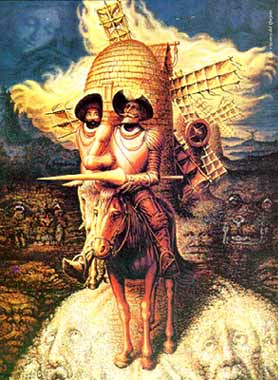
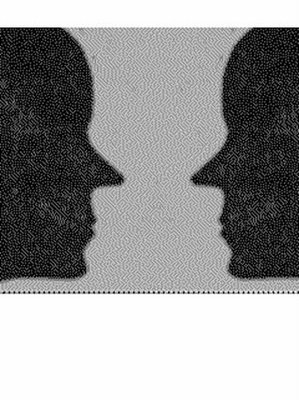
What do you see (#2)?